RAIN Labs supplies robotics kits, programs and classroom tools to schools and homeschool families across Australia, built so any educator can run a real engineering unit with no prep.
When a lesson needs something that doesn't exist, I design it, build it, run it and refine it. From learning games and design tools in the classroom, to semantic data engines and multi-faceted dashboards for business.
I'm Matthew, a Digital Technologies & Robotics teacher.
My pattern is simple. When a class needs something that doesn't exist, whether that's a way to teach workflow to Year 7s, to building custom LLMs simply, I design it, build it, run it with students/clients and refine it. This site holds those tools and the thinking behind them.
Principles
01
Learning first, tech second
Every tool starts from a learning intention. The Delivery Challenge is about systems thinking, and the software only keeps score.
02
Design for the real classroom
That means blocked APIs, managed devices, a dozen teams and one teacher. If a tool doesn't survive a Tuesday period 5, it doesn't ship.
03
Safe and inclusive by default
Written codes of conduct, teacher moderation, classroom-safe AI prompts, API keys kept on the server, and room for learners with additional needs.
04
Hand it over
Build so teachers and students can run it themselves. Adoption should become a skill people keep, not a dependency on me.
“Our roles need to evolve too, and be regularly and effectively evaluated in order to stay relevant.”
M.V., 2026 · see
Outside the classroom
I run (a teacher-run digital technologies hub with the Gametron and Plant Bot kits and free teaching tools) and (AI automation and training for small businesses). I'm also building , a homeschool community directory, for our family charity. All three keep me close to how people outside schools learn and use technology.
Delivery Challenge used in class
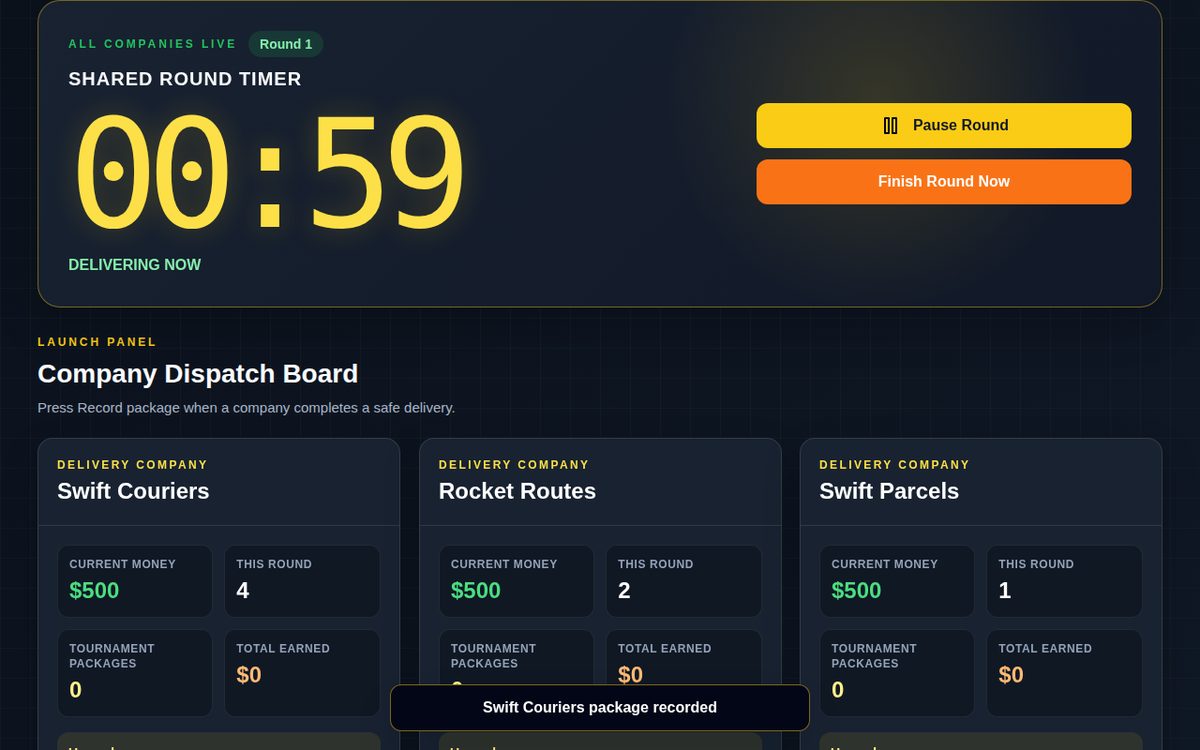
Live round: shared timer and company dispatch board (teacher view)
AudienceYear 7
ConceptWorkflow & systems thinking
FormatPhysical team tournament
My roleLearning design + build
The learning problem
"Workflow" and "process improvement" are abstract for 12-year-olds. Explained on a slide, they mean nothing. Once students have actually felt a process break down, they understand them.
The design
Each class group becomes a delivery company with a name and a starting budget. In timed rounds, companies carry packages from a start zone to delivery points. A package only counts when the teacher records a safe delivery. Between rounds, companies spend their earnings on upgrades. To spend well, they have to look at where their process slowed down and fix it.
01
Companies
Up to 12 teams, each with a name and starting money.
02
Round setup
Shared timer (10 s–60 min) and a value per package.
03
Live round
A dispatch board where the teacher records each safe delivery.
04
Results → improve
Leaderboard, upgrade shop, next round.
Safety built into the rules
All trips are walked, and packages are carried, never thrown.
One person moves a package at a time, and they return to start before the next delivery.
The teacher is the only one who records a delivery, so scoring is fair and visible.
Why it matters for curriculum design
The software only keeps score. The learning comes from the structure: repeated cycles of do → measure → reflect → improve. The same shape carries into design and engineering processes in later years.
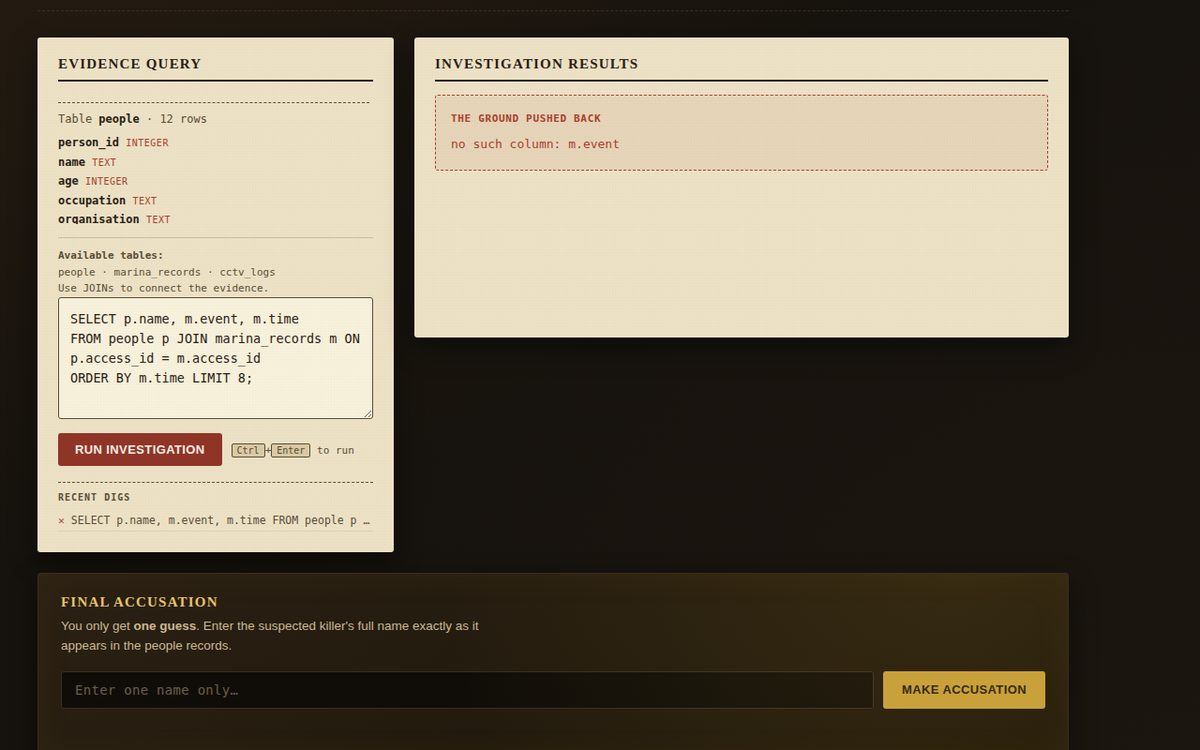
Evidence query console with investigation results and the one-shot accusation
AudienceSecondary Digital Technologies
ConceptRelational data & SQL JOINs
FormatForensic investigation
My roleScenario, data & build
The design
A suspicious death at the marina. Detectives have recovered three evidence tables: people, marina_records and cctv_logs. Students write SQL to join the evidence, reconstruct movements and compare timestamps until one person's story doesn't fit the records.
The key design decision is that students get one guess only. Guessing has a cost, so the task pushes students to build and test their reasoning before they commit. That is the same habit good assessment rewards.
What students practise
Reading a schema and working out how tables relate
Writing JOINs across three tables and filtering by time windows
Treating query output as evidence and cross-checking it against a second source
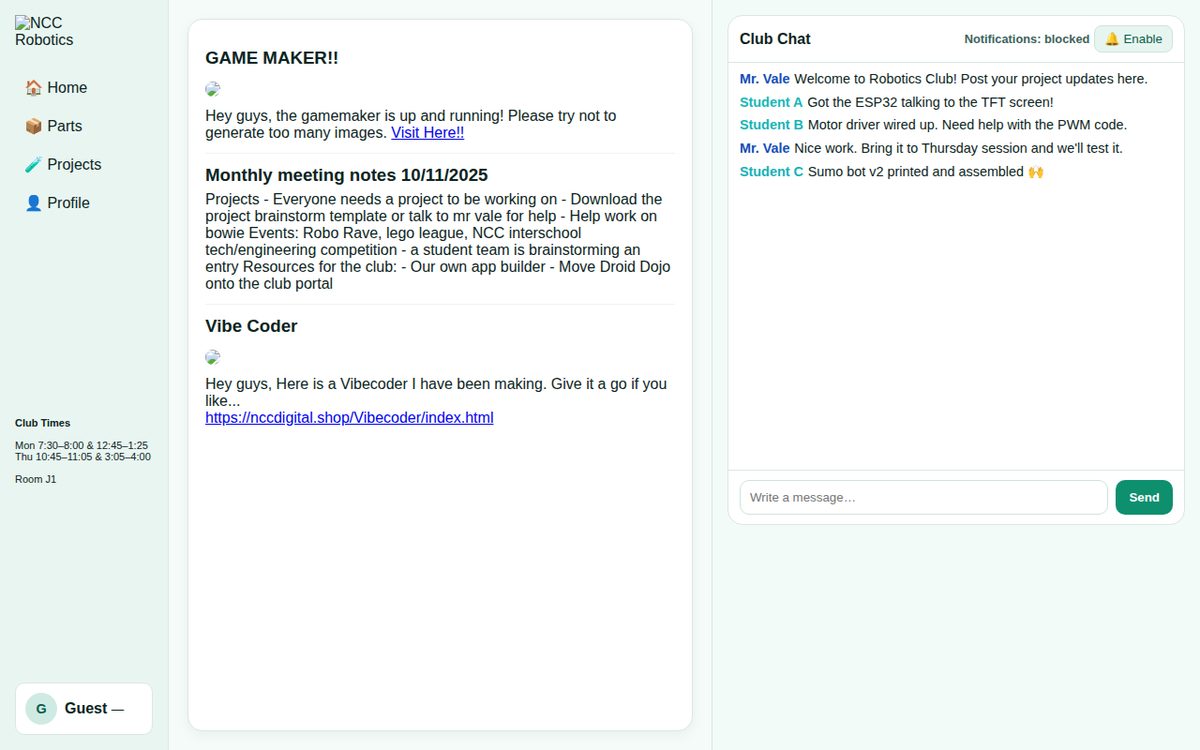
NCC Robotics Club platform: news, meeting notes and club chat (demo data)
AudienceYear 8 · Robotics Club · staff
HardwareESP32-C3/S2, Edison, TFT, DC motors
ProcessesDesign · build · test · iterate
My roleTeacher, club lead, toolmaker
This is the applied end of my teaching: students designing, wiring, programming and testing physical systems. Where existing school tools fell short, I built the missing programs. add: Engineering / Engineering Skills / Industrial Technology teaching here
NCC Robotics Club
A lunchtime and after-school club (Mon & Thu, Room J1) with its own platform. Members have profiles and project logs, and there's a searchable parts inventory with specs (ESP32-S2 boards, DC motors and more), club news, monthly meeting notes and a club chat. Every member is expected to have a project on the go, and the platform makes that visible.
Builds & tools
What this shows
Engineering processes in practice. Specification, prototyping, testing against a competition or brief, and iteration.
Managing a technical learning environment. Inventory, fabrication queues, device flashing and safety.
Lowering barriers for teachers. Browser-based tools mean no software installs on managed school devices.
AI in the classroom shipped
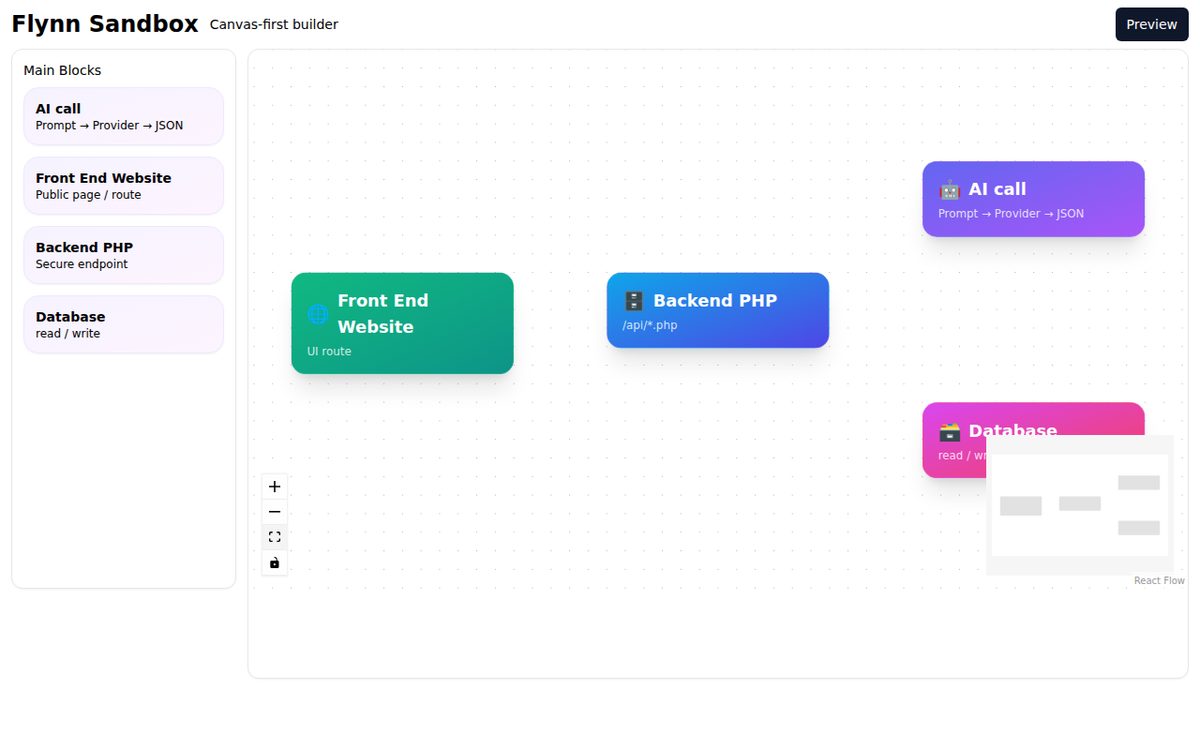
Flynn sandbox: students wire a front end, a PHP endpoint, an AI call and a database as blocks
Flynn: AI fundamentals for Digital Technologies teachers
Flynn is a school-ready platform for teaching how AI API calls actually work. It's visual and sandboxed, with separate teacher and student portals, so students can explore prompt engineering safely and in line with school values. It's built for teachers who aren't developers.
Keys never touch the browser. Every model call goes through a server-side proxy, so nothing leaks to student devices.
Classroom-safe by default. System prompts keep responses age-appropriate, and the teacher controls settings.
Show the machinery. Students see what a request and response look like. It's a system to understand, not magic.
R.A.I.N. Labs live
R.A.I.N. = Robotics and Artificial Intelligence Network
RoleFounder, designer & teacher
WhatKits, projects, programs, tools
ForClassrooms & homeschool families
ReachAustralia-wide, free AusPost delivery
R.A.I.N. Labs is an online digital technologies hub run by teachers. It supplies robotics and digital technologies equipment, projects and programs to classrooms and homeschool families across Australia. Every kit is designed to be ready to teach, with no prep and no guesswork, so a teacher who isn't an engineer can still run a real engineering unit.
Gametron Level 2
A DIY retro arcade machine. Students build a games console from scratch, program the games, customise the graphics and see how electronics and code fit together.
Microcontroller programming
Retro game design
Electronic circuit building
3D design concepts
Robot assembly skills
Gametron grew out of the Mini Arcade Generator I built for Robotics Club (ESP32-C3 and a 160×128 TFT). The club prototype became a kit that any class can run.
Plant Bot IoT
An IoT project where students build a smart plant system they can monitor and control online. It's a way into sensors, WiFi communication, automation and real-world systems.
WiFi-connected monitoring with live sensor readings
Automated watering system
Mobile app control through a web portal
Plant growth experiments that link to science
Both kits come as a Class Pack or a Homeschool Pack.
Free teaching tools
These are classroom tools built by a teacher, for the classroom. Anyone can launch each tool a few times a day for free, and Pro unlocks unlimited launches. Several started life as quick tools in my own lessons and were rebuilt as products.
Free3 launches a day, per tool
Pro · $9.95/moUnlimited launches on every tool
What teachers and families say
“My class asked to keep building robots after the unit finished. That doesn't happen with a worksheet.”Lauren Brown
“RAIN Labs gave us a homeschool project my kids actually looked forward to on a Monday morning.”Sarah Douglass
“Everything arrived ready to teach. No prep, no guesswork, just a lesson that worked straight away.”Michael Lippard
Workshops & governance
For face-to-face workshops, I wrote and run the terms and conditions and a student code of conduct. They cover supervision, safe equipment use, photo consent, respectful teamwork and reporting unsafe behaviour. Participants with additional needs, including NDIS participants, are supported within the program. Sessions are run by a registered teacher with NDIS worker screening.
Homeschool families spend real time hunting for programs they can trust, and small providers have no affordable way to be found. Communie is a directory that fixes both sides. Providers pay a modest subscription to list their programs, and families browse and connect for free.
The next piece has the most curriculum in it: an AI-assisted family dashboard that matches a family's programs and learning activities against QLD homeschool requirements to draft their reports. It sits on its own parallel schema, so new work can move quickly without putting the live app at risk.
communie-brand.png · working direction
Off-white
Charcoal
Eucalyptus
Warm accent
“Your community. Your learning. Your way.”
Learning happens in community.
The Communie FlowerFive petals for families, providers, groups, learning and events, read as one shape.
Harvest Oak Digital active practice
harvestoak.digital
RoleFounder & solo builder
WorkAI automation, PHP apps, training
ForSmall & medium businesses
StatusOngoing, contract-based
My contract practice. I sit with a team's actual workflow, build the tool it needs, then train the team to run it themselves. It's the same approach I take in the classroom: adoption should be a skill people keep, not a black box they depend on.
01
Problem intake
Find what's slow, manual or risky before writing any code.
02
Build
An automation or custom PHP tool scoped to the real process.
Generative AI has drastically affected many roles and processes. As it does, our roles need to evolve too, and be regularly and effectively evaluated in order to stay relevant. It's striking that some once-specialised roles, like software engineering, graphic design and data analytics, can now hand most of the heavy lifting to AI.
Rather than replacing our roles, adopting AI in the workplace, including the classroom, should be a considered, moderated process that ultimately improves workflow and output. It shouldn't stand in for the work itself.
The real power isn't the novelty of a chatbot. It's using the same pattern recognition in the daily grind of processing data, planning, and preparing staff and student documents, so the actual work moves faster and teachers get time back for teaching.